
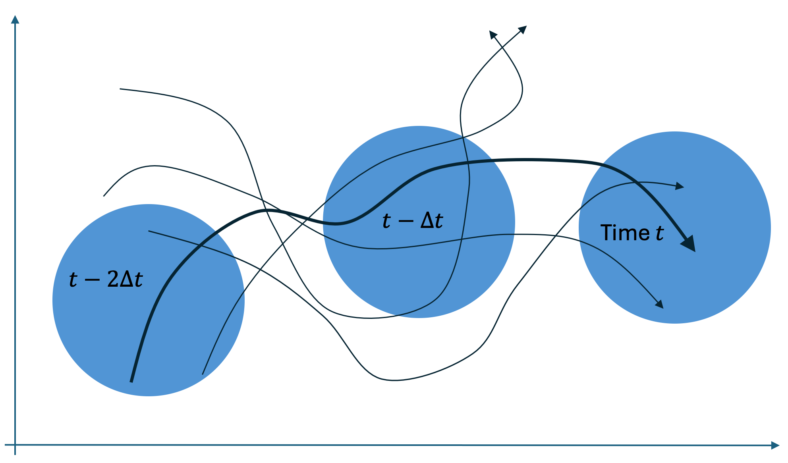
Trajectories are golden information in the study of dynamical systems like cells. If we can follow individual cells in time, then we can learn what events precede others and in principle infer all kinds of wonderful mechanistic information.
The problem is that measurements that reveal high-dimensional omics information for single cells require killing the cells, whereas observing cells in real time via video microscopy doesn’t reveal too much molecular information. Although modern live-cell microscopy techniques enable labeling specific cellular proteins to reveal their spatial and temporal intra-cellular behavior, this is limited to a literal handful of proteins (at once). And there’s always the worry that the labels may alter the behavior of cells.
So the question is, How can we learn detailed information for single cells as they change and move in time? In other words, can we learn about (apparently) hidden information?